

- Home >
- Artifacts of IP Heritage >
- 2025 >
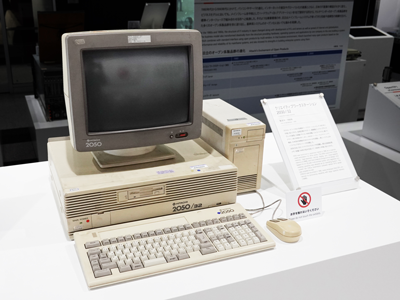
- Hitachi Creative Workstation 2050
Hitachi Creative Workstation 2050
| Manufactured in | 1988 |
|---|---|
| Manufactured by | Hitachi, Ltd. |
| Owner | Hitachi, Ltd. |
| Location of historical materials | Hitachi, Ltd.
292 Yoshida-cho, Totsuka-ku, Yokohama-shi, Kanagawa, 244-0817, Japan |
| Visitor information | Not open to the public (Ask for a visit) |
| Contact | https://www.hitachi.co.jp/products/it/portal/museum/ |
Hitachi Creative Workstation 2050, announced by Hitachi, Ltd. in 1985, was an epoch-making product designed to serve as a core of office automation (OA). Developed with an aim of transforming the then-current office-based intellectual work - paper and manual operations depended for a long time - into more creative and knowledge-intensive operations, the workstation introduced cutting-edge technologies that had previously been unprecedented in office environments.
The system featured a high-speed 16-bit processor (68010), along with Hitachi's newly developed bitmap processor and numeric processor. Combined with a high-resolution bitmap display and a mouse-driven user interface, it offered an advanced machine user experience. Its operating system, HI-UX, was based on UNIX and supported OFIS-EV series, an integrated OA software suite. Running these applications within a multi-window environment enabled simultaneous reference to multiple information sources and parallel execution of tasks. One of the Workstation's most distinctive features was its compatibility with a data stream of T-560/20, an online terminal for Hitachi's HITAC M-Series mainframe systems. This allowed the workstation to seamlessly handle both advanced knowledge-intensive operations by OA functions and mission-critical business operations by the online terminal on a single platform.
The model certified as an Information Processing Technology Heritage, 2050/32 (released in 1988), was a performance-enhanced follow-onthat inherited the original 2050 concept. Equipped with a 32-bit 68020 processor, it delivered approximately three times processing performance and ten times display performance. It had also strengthened horizontal distributed processing capabilities, including LAN-based file sharing. By closely integrating mission-critical systems with OA and establishing a foundation for desktop information processing, the Hitachi Creative Workstation 2050 series played a pivotal role in advancing OA technologies. It is recognized as one of the important information processing technologies that led the innovation of office work in Japan.
